Biomedical Tattoo - Undergraduate Research
Entering my freshman year, I reached out to Enrique Velasquez Morquecho, at the time a Ph.D. student who had given a lab tour during an engineering camp I attended a year back. Interested in his many projects spanning from stress sensors to electrosurgery, I joined his biomedical tattoo project under Dr. Wei Li's Nano and Bio Materials Manufacturing Lab.
There I was placed to research the temperature measurement for this device. Researching thermocouples and later thermistors, I gained experience in reading and analyzing research literature to discover the feasibility of utilizing either of these components in our device.
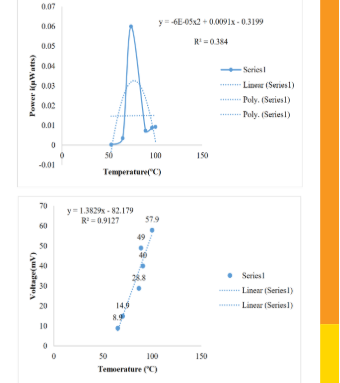
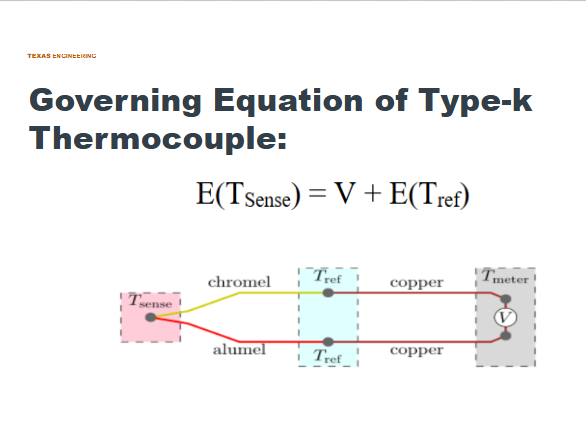
Additional literary findings from final presentation.
Additional literary findings from final presentation.
The main two articles I used to base my findings were “Experimental Design, Characterization, Coupling and Calibration of Type-k Thermocouple” by: Igwilo O.C, Mathurine G, Onyegbadue I, and Azike R.U and “Accurate Temperature Measurements for Medical Research using Body Sensor Network” by: Carlo Alberto Boano, Matteo Lasagni, Kay Romer, and Tanja Lange.
Initially I was researching thermocouples, hoping to find a component that would accurately measure the temperature of the wearer using the voltage caused by the heat. Then realizing the thermocouples would be most accurate in the temperature ranges of 65℃ - 100℃, with the optimal peak temperature of 76℃, I realized the temperature range was too low compared to a human's. Upon realizing this, I moved my research focus to thermistors.
Using the second article in addition to other supporting articles, I found that thermistors would be more accurate at sub 105°F no lower than 95°F at an accuracy of ±0.1°C or ±0.2°C. This would be suitable for human temperature readings. From there, I found multiple candidates for purchase, reading manufacturer's datasheets to find components with optimal temperature range and tolerance. By the end of the year, I created a presentation, laying out my literary findings, the purchasing candidates, and future steps for the upcoming year ready to be presented to the rest of the lab.